John Smith
choral music composer
John Smith has had a long career in choral singing and music education. As a composer of choral compositions he values singability and an understanding of the human voice as a lyrical instrument.
John Smith's Compositions
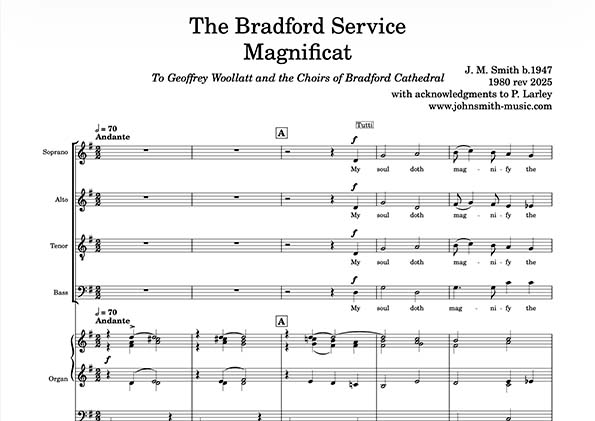
Written to celebrate Bradford’s City of Culture 2025. The Magnificat and Nunc Dimittis are closely linked, sharing a concluding Gloria that reworks material from the Magnificat’s opening. They open out of key with bold organ chords before settling into G major, with two soprano trios built over a descending bass line. A sustained G pedal conveys calm before increased movement leads into the Gloria.
The original Unison version of this medieval carol was written around the year 2000 for the choir of Saighton Church of England school in Chester where i was director of music. This version has now been rewritten for SATB choir. The carol is a narration of the conversation between the Virgin Mary and the Angel Gabriel.
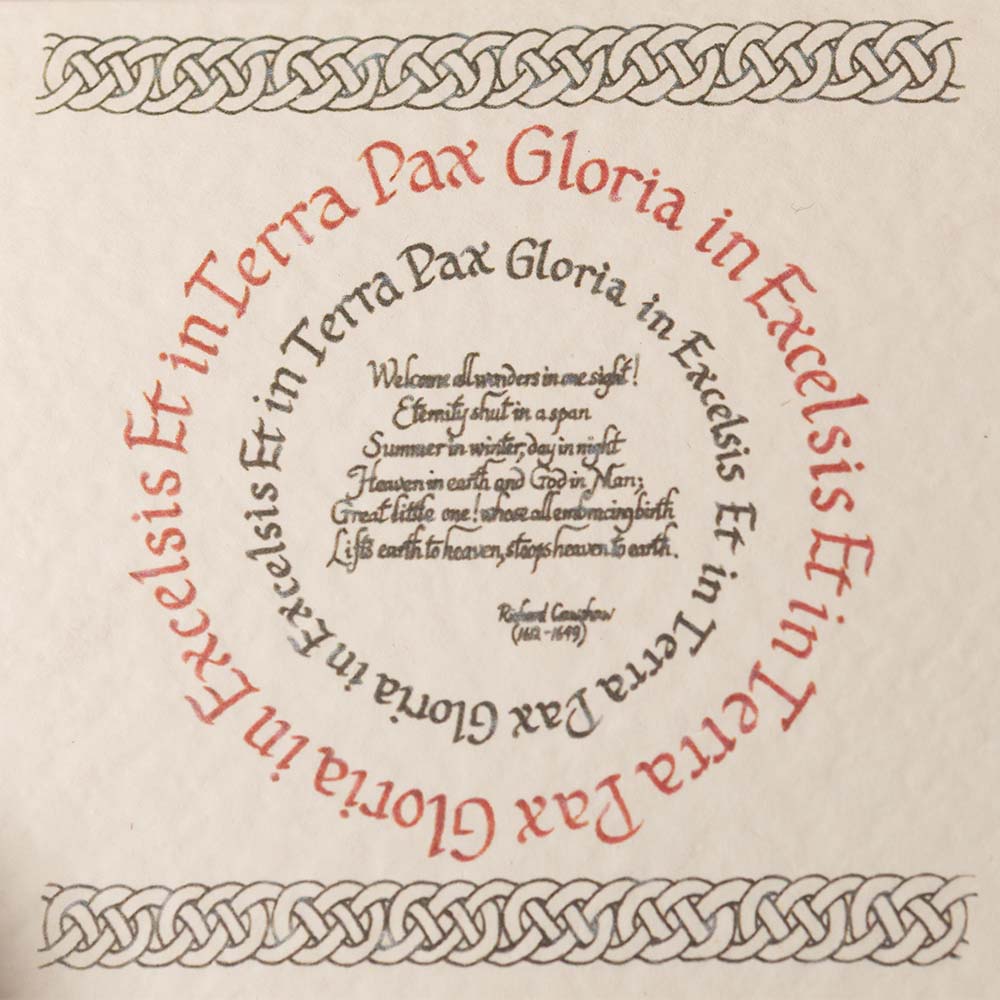
The genesis of this carol was inspired by the shepherds reaction to the angels message of Christ’s birth. The first section of the carol attempts to convey the “all embracing” nature of the text with it’s distinct contrasts. The carol has a concluding section which begins with a distant choir of angels to the text “Gloria in Excelsis Deo”. This section is announced with a fugato, the subject of which is derived from the opening section “Welcome” and which after the words “Pax” returns with the added emphasis of the angels to conclude with a climactic a climactic “Gloria”.
One of three communion motets influenced by plainsong
These 3 short motets for parish choir were influenced by gregorian chant. The compositions make initial reference to the respective chant before evolving in sympathy with the text and chant style. The style pervades all four voices and the method of performance should reflect something of the rhythm and style of the chant.
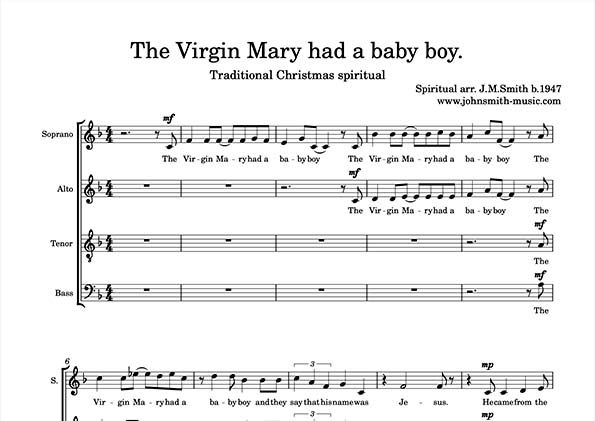
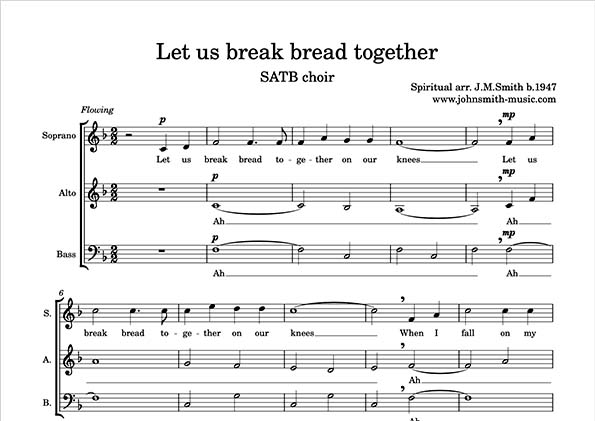
The last of of three spirituals. “Swing low, sweet chariot” was written for St George’s day service at grosvenor Chapel Mayfair. “Let us break bread together” is intended as a communion anthem and begins with the simple basic harmonisation of the tune before the melody diffuses into the other voices. “The Virgin Mary had a baby boy” is much lighter in character and was originally written for a choir in the Netherlands. Each verse transposes up a semitone in order and a high soprano solo is added in the third verse.
One of three spirituals. “Swing low, sweet chariot” was written for St George’s day service at Grosvenor Chapel Mayfair. “Let us break bread together” is intended as a communion anthem and begins with the simple basic harmonisation of the tune before the melody diffuses into the other voices. “The Virgin Mary had a baby boy” is much lighter in character and was originally written for a choir in the Netherlands. Each verse transposes up a semitone in order and a high soprano solo is added in the third verse.
This short mass for female voices was written for Fallowfield Church of England Girls High School in Manchester where John was director of music in the 1970s. The mass makes use of a short head motif except for the Sanctus which begins with a three part canon.
This setting of Ubi Caritas et Amor is scored for SATB without divisi. It is suitable for parish church choir as a communion motet or occasional anthem. This setting was composed by John Smith in 2016 for the wedding of Laura Wadsworth and Archie Montgomery.
It is one of three communion motets influenced by plainsong
These 3 short motets for parish choir were influenced by gregorian chant. The compositions make initial reference to the respective chant before evolving in sympathy with the text and chant style. The style pervades all four voices and the method of performance should reflect something of the rhythm and style of the chant.
A setting of the communion motet Tantum ergo by John Smith for SATB choir a capella.
It is one of three communion motets influenced by plainsong
These 3 short motets for parish choir were influenced by gregorian chant. The compositions make initial reference to the respective chant before evolving in sympathy with the text and chant style. The style pervades all four voices and the method of performance should reflect something of the rhythm and style of the chant.
One of the arrangements of three spirituals. in John Smith’s Opus 5. “Swing low, sweet chariot” was written for St George’s day service at Grosvenor Chapel Mayfair. “Let us break bread together” is intended as a communion anthem and begins with the simple basic harmonisation of the tune before the melody diffuses into the other voices. “The Virgin Mary had a baby boy” is much lighter in character and was originally written for a choir in the Netherlands. Each verse transposes up a semitone in order and a high soprano solo is added in the third verse.
An evening motet is modal in style and has a clear structure. Each phrase forms an arc, each verse is an arc and all three verses form an arc. The first and last verse are centered around F, whilst the second verse is centered around C touching on G at the climax to the piece. Care should be taken of the dynamics in performing the piece.
This motet received its London premiere in the London festival of contemporary church music 2025.
The first half of this piece which is in e minor is scored for four upper voices and grows outwards from a solitary E. The second half introduces the tenor and bass voices and is in the relative major G. It has an inversion of the opening 1st Soprano line moving from the dominant to the tonic. When the upper voices enter they are a transposition of the music from the first half. After a brief passage introducing E flat and B flat the whole piece concludes in the key of E. This piece received its premiere at the London Festival of contemporary church music 2025.
This work for female chorus was written as a Christmas piece for Fallowfield Church of England Girls High School in Manchester where John was director of music in the 1970s.
This piece was written for my younger son’s wedding. The main key of the piece is in D major. It touches on various keys throughout and the movement from the F# major chord to the Soprano solo in G major takes the music into a different realm before the final section in D major which introduces the long held D in the word “Love” which is heard at the beginning before the final climactic ending.
it is a Setting of Edmund Spenser’s “An Hymne of Heavenly Love” for SATB with minimal divisi SSAATB